


Quick Overview
ITIL 5 may sound like another framework refresh, but for release managers, the real question is what it changes in daily release work. Here, you’ll see what matters beyond certification: why releases no longer end at deployment, why a green pipeline is not enough, and how better visibility, post-release validation, and automation governance can support stronger release decisions.
Your team leader forwards you a link with the subject line: “ITIL 5 is out.”
Your first thought is probably not excitement. It's "do I need to re-certify," followed closely by "does this change how I actually run releases, or is it another framework refresh I have to pretend to care about ?."
Your ITIL 4 knowledge still matters, and the new version does not erase your achievement. Check your certification renewal date separately. The more useful question, the one this article is about, is what ITIL 5 changes for the people who plan, coordinate, and ship releases. A few things genuinely do shift, and they line up with what good release teams have been doing for years anyway.
Let's get the comparison out of the way first, then talk about what it means on a Tuesday when a release is moving toward production.
ITIL 4 vs ITIL 5: The 30-Second Version
PeopleCert calls the new framework ITIL (Version 5) in its training and certification materials. It builds on ITIL 4, with a broader focus on digital products, services, AI and user experience. The familiar guiding principles and four dimensions remain useful foundations; the 34 management practices continue with adjustments to align them with the new guidance.
Area | ITIL 4 (2019) | ITIL 5 (2026) |
|---|---|---|
Operating model | Service Value Chain | Product and Service Lifecycle |
AI and automation | Enabler within practices | AI-native guidance, with explicit governance and accountability |
Experience | Part of stakeholder value | Stronger focus on digital experience across the lifecycle |
Scope | IT service management | Full digital product and service lifecycle |
For a clearer starting point, you may also want to read our ITIL 4 Deployment Management guide, which explains the foundations behind release and deployment management before comparing them with ITIL 5. And if you prefer a more visual and practical format, we created the ITIL 4 ebook to make the topic easier to understand and apply in real release work.
ITIL 4 Foundation remains an accepted route into higher-level ITIL (Version 5) modules. The optional Foundation Bridge offers an update. As of September 24, 2026, PeopleCert plans to retire all ITIL 4 modules and the Foundation Bridge on December 31, 2027. Certificate renewal is separate. Check PeopleCert and its current transition FAQ before booking.
That's the cert question handled. Now, the part that matters for your releases.
The Framework Caught Up to Practice
Here's what most "what's new in ITIL 5" articles miss: The headline change isn't really new. It's ITIL catching up to how mature release teams already work.
For years, the unspoken rule was that a release manager's job ends at deploy. Pipeline goes green, ticket closes, done. The good teams never believed that. They judged a release by whether it was stable, adopted, and delivered the promised outcome. ITIL 5 just writes that down as the model.
So if you've been treating releases as outcomes across environments rather than a deploy that either fired or didn't, ITIL 5 isn't asking you to change. It's giving you the language to defend what you already do.
Three shifts make this concrete.
1. The Release No Longer Ends at Deploy
ITIL (Version 5) describes a Product and Service Lifecycle covering Discover, Design, Acquire, Build, Transition, Operate, Deliver and Support. These activities can overlap across different work streams.
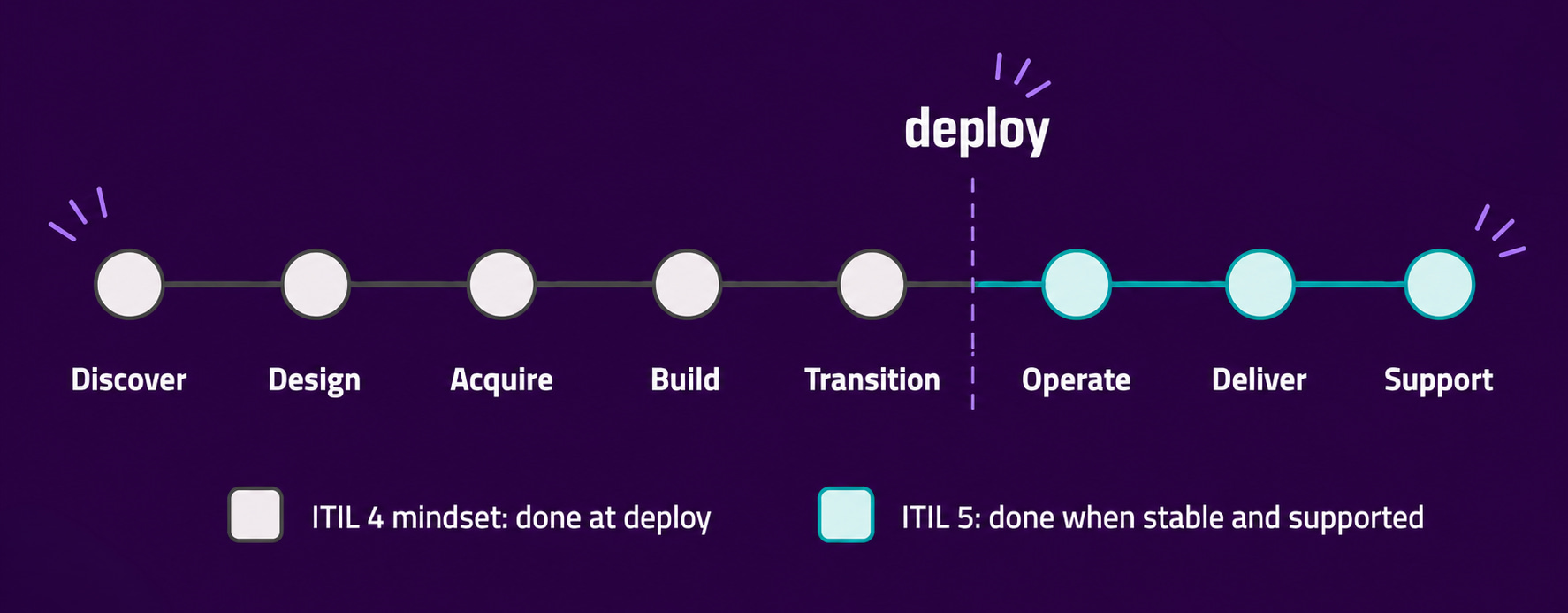
For release managers, this is a useful prompt to connect deployment decisions with what happens in operation and support. Agree who checks stability, adoption and user impact after a release, and make those checks visible to the teams involved.
In practice, this changes what "ready" and "done" mean. Ready stops being "tests pass, and the window is open". It becomes "the target environment is healthy, approvals are in, nothing downstream is blocked." Done stops being "deployed." It becomes "deployed, stable, and confirmed in operation."
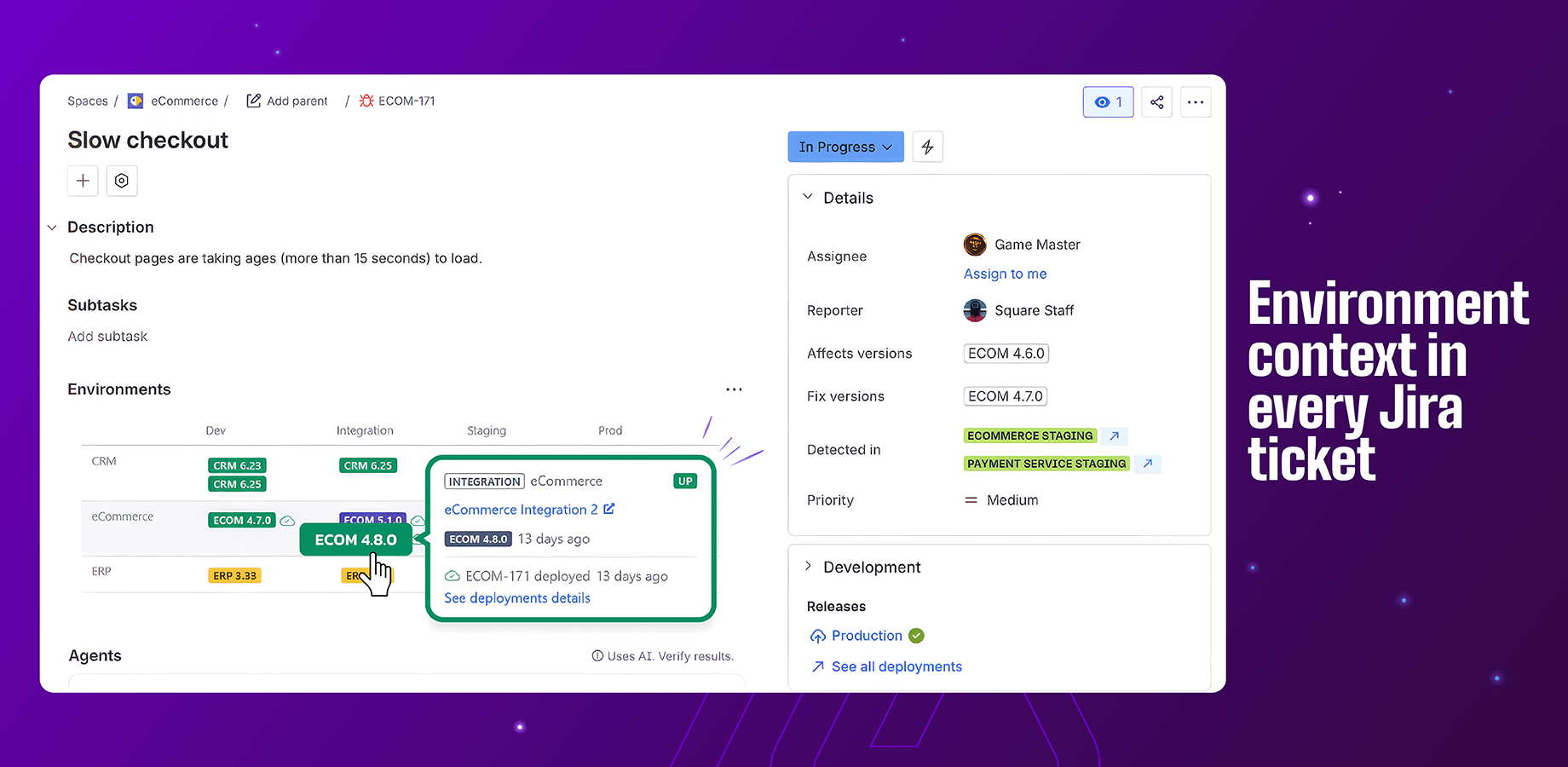
For most teams, the gap isn't the idea. It's that the information lives in five places: the pipeline, a monitoring tool, a Jira board, a Slack thread, and someone's memory. The lifecycle exists. Nobody can see it end-to-end. That's the real work.
2. A Clean Deploy Is No Longer a Successful Release
ITIL (Version 5) puts more emphasis on digital experience across the product and service lifecycle. Review users' experience alongside operational measures such as availability, response time and incident rates.
For a release manager, that's a slightly uncomfortable idea. It means a deployment can be technically flawless, zero errors, zero rollback, and still be a failed release if the people on the other end can't use the change, weren't ready for it, or never noticed it solved their problem.
You've felt this. Everyone has shipped something perfect that landed with a thud. ITIL 5 stops treating that as someone else's problem.
The practical shift is in your definition of success. A green pipeline is necessary but not sufficient. The questions that used to be optional move into the release itself: was the change communicated, was support briefed, did adoption happen, did the thing move the number it was supposed to move?
3. When an Agent Ships the Change, Who Owns the Release?
This is the genuinely new one. ITIL 5 is built assuming AI and automation are normal operating conditions, and it adds dedicated AI governance guidance to match.
For release and deployment work that lands on a question the industry has been quietly avoiding. Automation already triggers builds, promotes versions, and in plenty of shops approves and executes deployments with no human in the loop. Great for speed. But when an automated release causes an incident at 2 am, the questions are real: what rule fired, what did it check before acting, who is accountable, and where is the trail.
ITIL 5 frames this as governance, not a brake. The point isn't to slow automation down. It's to make automated changes as visible and traceable as the ones a human signs off on. Every automated promotion should leave the same record as a manual one would: what changed, where it went, what gated it, what it touched.
So What Do You Actually Do About It?
All three shifts come back to the same thing. You can't manage what you can't see. The lifecycle, the experience, and the automated decisions all assume someone has a clear, current view of what's happening across environments and releases.
Picture one release through the ITIL 5 lens. Before it moves, you can see the health of the target environment pulled straight from your monitoring tools, not chased down in a Slack thread. You can see what else is booked into that environment and whether a blackout window is in effect, so two releases don't collide. The fix version was tagged automatically when the pipeline ran, so the record is accurate without anyone updating a ticket. You make the go or no-go call against what's actually in front of you, and after the release, you can still see how it's running.
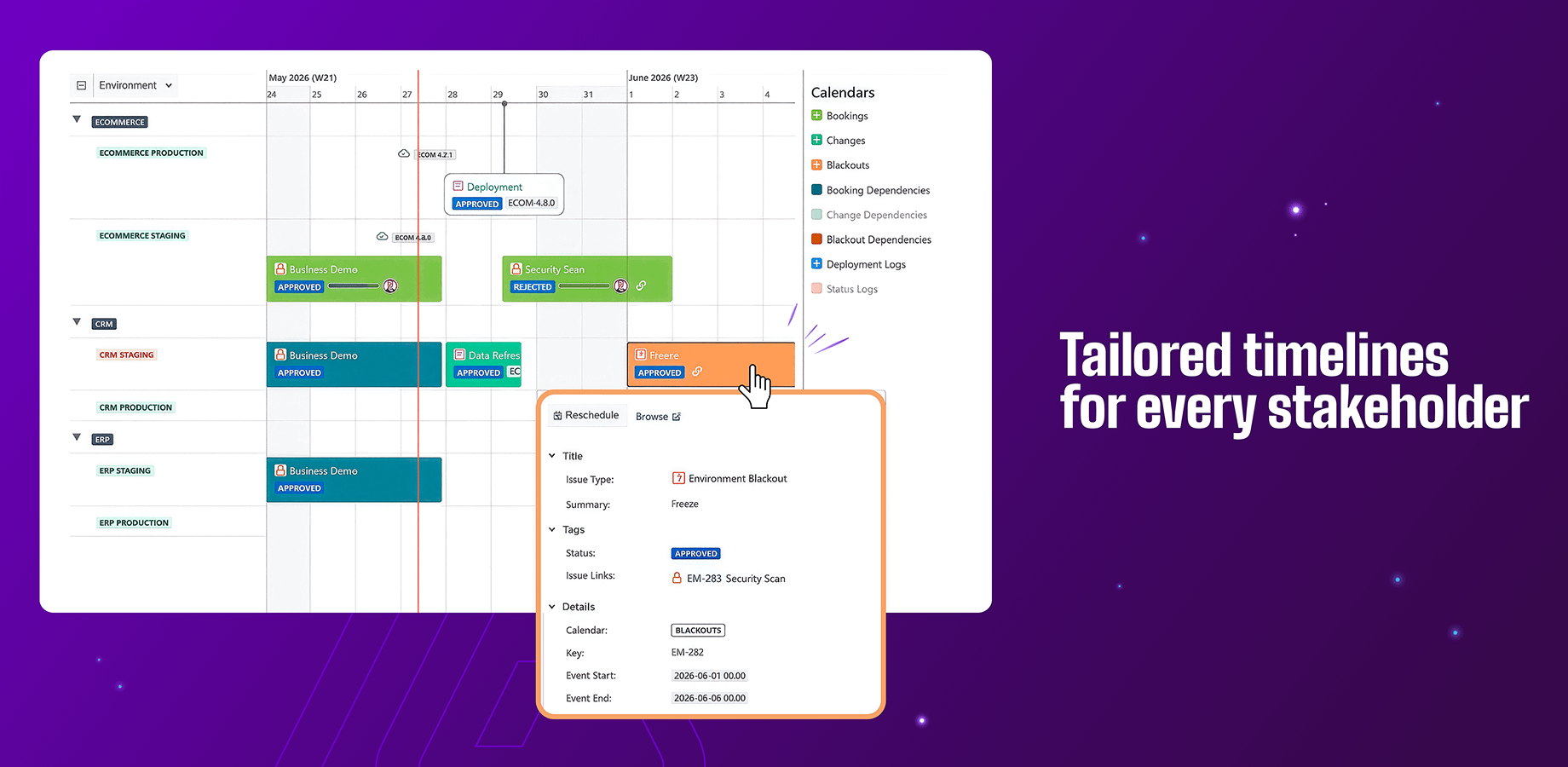
That's the lifecycle made visible. In Jira, that's roughly what Apwide Golive is for, but the principle holds whatever you use. ITIL 5 says judge the whole lifecycle, so you need to be able to see the whole lifecycle.
The Framework Moved, the Work Didn't Have To
ITIL 5 didn't invent the deliberate release. It's named it.
If you were already treating a release as an outcome across environments instead of a deploy that either worked or didn't, the framework just caught up to you. If you weren't, this is a good nudge, and there's a map for it.
Want the Operating Manual, Not Just the Shift?
This article covers what changes. The ebook covers what to do about it. Chrissy Clements, ITIL Master and Ambassador, wrote The Deliberate Release: A Practical Guide to Managing Services and Releases with ITIL. It turns these shifts into the frameworks you actually run a release on: the Four Dimensions as a release-risk checklist, the seven guiding principles applied to real release decisions, and a clear line between release, deployment, and change enablement.
Key Takeaways
- Treat ITIL 5 as a way to improve your current release process, not as a reason to start over.
- Redefine “done” so that a release is not complete until it is deployed, stable, and confirmed in operation.
- Check environment health, approvals, dependencies, and blackout windows before making a go/no-go decision.
- Look beyond the green pipeline and ask whether the release was communicated, adopted, and useful for the people receiving it.
- Bring support, monitoring, and user impact into the release conversation earlier, not only after something goes wrong.
- Make automated deployments traceable by recording what changed, what triggered the action, what checks were passed, and who owns the outcome.
- Centralize release information so deployment status, environment availability, monitoring data, and support readiness are not scattered across tools and conversations.
- Use ITIL 5 as a stronger argument for what mature release teams already know: a successful release is an outcome, not just a deployment.
FAQ | ITIL 5 vs ITIL 4
Yes. ITIL 4 qualifications remain recognized for progression. As of September 24, 2026, PeopleCert plans to retire ITIL 4 modules on December 31, 2027. That date concerns the modules; your certificate has its own renewal date.
For a new learner, start by comparing ITIL (Version 5) Foundation with your employer's requirements. If you're already studying ITIL 4, check your exam voucher terms and PeopleCert's transition guidance before changing course.
No. ITIL 4 Foundation can qualify you for higher-level Version 5 modules. Use the optional Bridge if you want to update your Foundation knowledge and qualification.
It is an optional update route with an exam leading to ITIL Foundation (Version 5). PeopleCert currently schedules its retirement for December 31, 2027.
ITIL (Version 5) builds on familiar ITIL concepts while giving more attention to digital products, the full product and service lifecycle, user experience and responsible AI governance.
ITIL 4 certifications need renewal every three years to stay current. Without renewal, your achievement remains on PeopleCert's register but is marked as outdated. Check your own renewal date in your PeopleCert account. The introduction of Version 5 and retirement of ITIL 4 modules are separate from that renewal cycle.
ITIL 5 assumes AI and automation are part of normal operations and adds governance guidance for automated decisions. For release managers, that means treating automated deployments with the same visibility and accountability as human-approved ones: clear records of what was changed, what was checked, and who owns the outcome.