


What if booking a resource in Jira started with a simple message instead of a form?
This is the direction Quabu Solutions explored when they set out to rethink how users interact with booking workflows.
In their original article - read the success story - they show how a request expressed in Jira Service Management can move through Rovo and Apwide Booking to become a completed reservation.
Behind this experiment lies a very concrete use case.
From IT Workflows to Real-World Bookings
Quabu was working on a scenario where clubs and organizations need to manage shared facilities, such as:
- swimming pools
- fitness rooms
- tennis and paddle courts
- and other reservable assets
These are physical resources with real-world constraints like limited capacity, specific time slots, and fixed locations.
And they needed to be booked through Jira Service Management.
This is where the challenge begins.
From Connection to Interaction
Rovo and Booking each brought the right capabilities. The opportunity was to connect them into a single, cohesive experience.
As Quabu explains in their article, this was achieved by enabling Rovo agents to access Booking through skills. This allows them to retrieve availability and create reservations directly, without breaking the flow of the interaction.
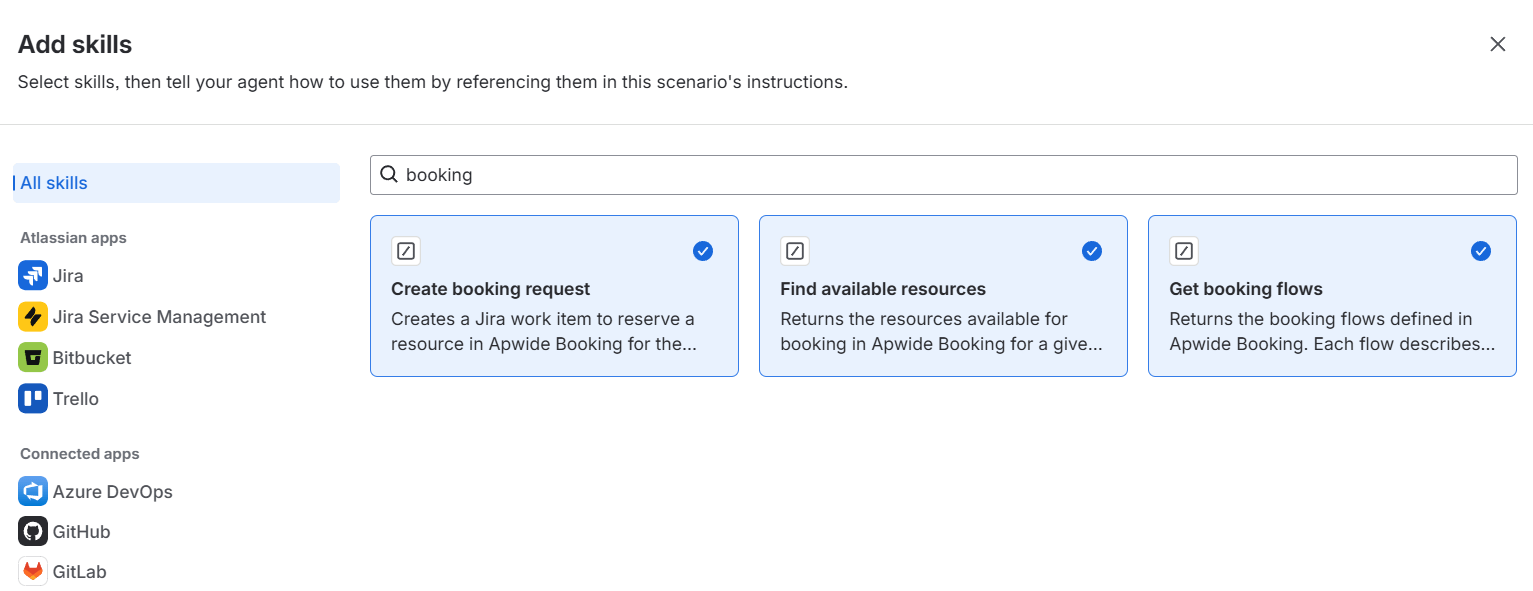
Booking Skills Available in Custom Rovo Agents
Quabu designed the flow so that a user request expressed in natural language could:
- Reach Rovo through the portal chat
- Trigger Booking actions via skills
- Return availability and confirm the reservation
What previously required navigating forms and fields now happens as a single, continuous interaction.
A Concrete Example: Booking a Tennis Court
Imagine a club member who wants to book a tennis court.
Instead of:
- opening a form
- selecting the asset
- choosing a time slot
- validating availability
They simply write:
“Book a tennis court tomorrow at 7pm.”
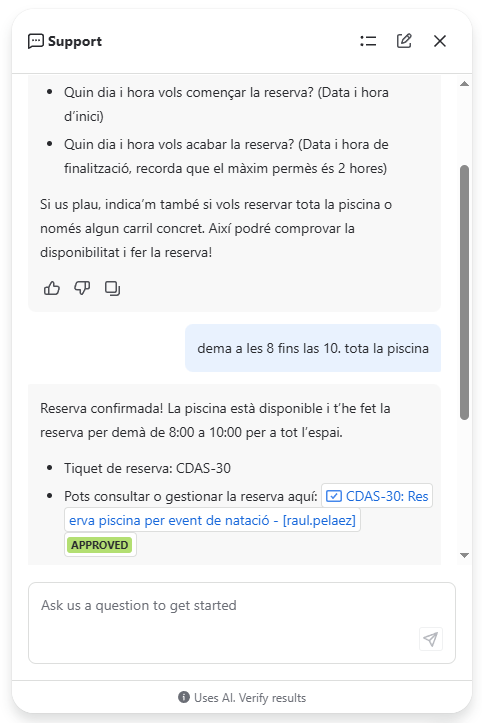
Booking a Resource from a Custom Rovo Agent
From there:
- Rovo interprets the request
- Booking checks availability
- constraints are applied
- The reservation is created in Jira
From the user’s perspective, this feels like a conversation.
Behind the scenes, it remains a structured, controlled process.
When Forms Become Optional
This is the core shift highlighted by Quabu.
Forms have structured Jira workflows for years. They ensure consistency and control, but they also introduce friction.
Quabu’s approach does not remove forms; it makes them optional.
As they put it, the key question becomes:
“Why would I fill out a form if the AI can do it for me?”
A Different Starting Point, Built on a Solid Foundation
Even as the interaction evolves, Apwide Booking continues to provide the structure behind the scenes - managing availability, enforcing constraints, and recording reservations as Jira work items.
What changes is not the outcome, but where the interaction begins.
Through this collaboration, Quabu Solutions demonstrates how Jira can support real-world operations such as facility management, shared resource scheduling, and service delivery through portals, while introducing a more natural way to interact with these processes.
A request expressed as a conversation can lead to the same structured result as a traditional form, without requiring users to translate their needs into predefined fields. And when both options coexist, usage tends to favor the simplest path.
So, five years from now, how will you book a tennis court?
A form… or a conversation?